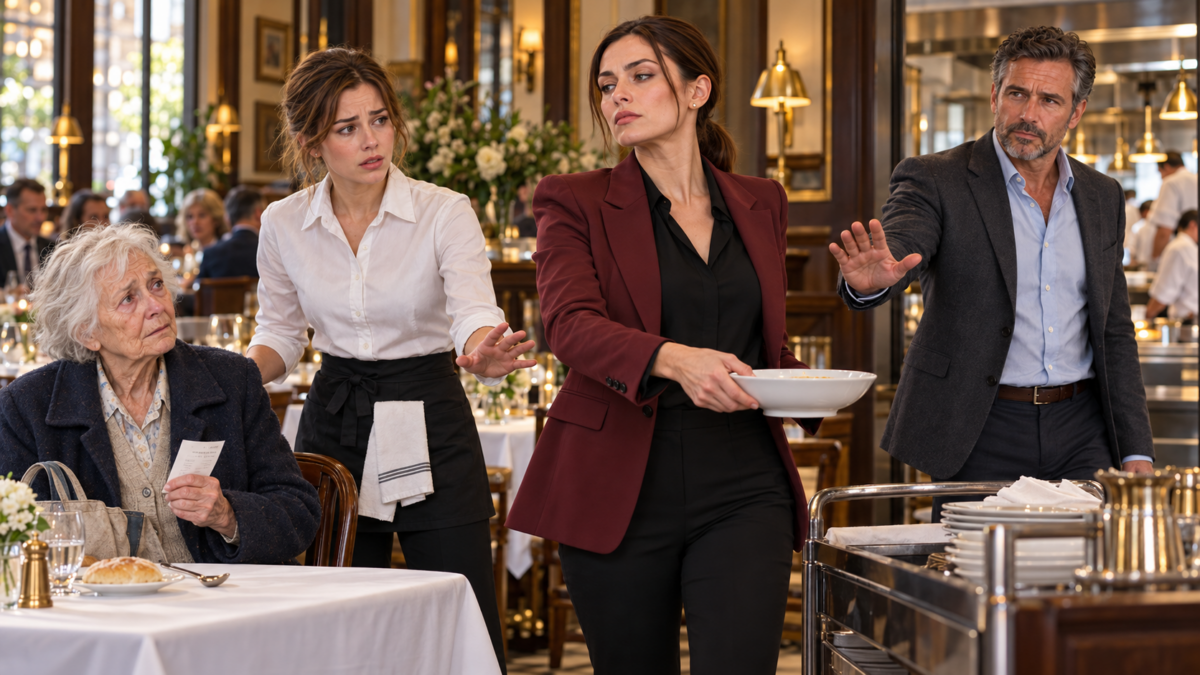
Rose Miller had counted the money twice before leaving her apartment.
Enough for a bowl of soup, a bread roll, and a small tip.
She tucked the bills into her purse, put on her navy coat, and took the bus to the restaurant where she had once spent twenty-three years washing dishes.
It was her late husband’s birthday.
They had both worked there long before the white tablecloths and brass lamps arrived. On his birthday, they used to share soup after the lunch rush.
Rose wanted to sit near the window and remember him.
That was all.
Emma, the young waitress who greeted her, never questioned the worn coat or faded canvas bag.
She found Rose a table, took her order, and accepted her cash when Rose asked to pay in advance.
“I don’t like worrying about the bill while I eat,” Rose explained.
Emma smiled and brought back her change and receipt.
A few minutes later, the soup arrived.
Rose had barely lifted her spoon when a hand reached across the table.
The bowl disappeared.
“Who let a beggar sit here?”
Rose looked up at the woman in the burgundy blazer.
“I paid.”
Vanessa Cole, the restaurant manager, glanced toward the neighboring tables.
Rose held out her receipt.
“The waitress has my receipt,” she added uncertainly, then looked down at the paper already in her hand. The sudden confrontation had flustered her.
Vanessa placed the soup on a clearing trolley.
“Then take it outside. You’re ruining the atmosphere.”
She took the receipt, crumpled it, and dropped it at Rose’s feet.
At the next table, a man lowered his fork.
Rose put her spoon down carefully.
She bent to retrieve the paper, but her knees made the movement difficult.
Emma hurried over.
“She hasn’t done anything wrong.”
Vanessa blocked her.
Then she picked up a cloth and wiped the place on the table where Rose’s hand had rested.
Rose watched the cloth move across the white linen.
Her cheeks burned.
“Out,” Vanessa said. “Before the other guests complain.”
Rose stood, clutching her canvas bag.
She reached inside for her glasses. A small plastic card slipped from the inner pocket and landed beside the table.
Before she could pick it up, someone else bent down.
“Rose Miller?”
Daniel Brooks had just come out of the kitchen.
He looked from the faded employee photograph to the woman standing before him.
“Rose. It’s Daniel.”
She studied his face.
“Mr. Brooks’s boy?”
He nodded.
His father had owned the restaurant when Rose worked there. Daniel had taken over several years earlier, after Rose retired.
He returned her old employee card.
Then he noticed the crumpled receipt in her hand and the untouched soup on the trolley.
Emma began explaining.
Vanessa interrupted.
“I was handling a situation.”
Daniel looked at her.
“Did you just throw her food away?”
“It’s on the trolley,” Emma said. “She hadn’t even eaten any.”
Vanessa gave a tight, nervous smile.
“She’s just—”
Daniel cut her off.
“Ask her how she paid for your surgery.”
The room went quiet.
Vanessa stared at him.
“What?”
Daniel looked at Rose’s bare left hand.
“The surgery you needed eleven years ago.”
Back then, Vanessa had been a waitress.
She was twenty-three, living alone, and saving to finish a hospitality course when a specialist told her she needed an operation.
Her insurance would cover part of it. The remaining expense, together with the weeks she would spend unable to work, was more than she could manage.
Daniel remembered finding her crying beside the staff lockers.
His father organized a collection. Employees contributed what they could. The restaurant added money.
It still wasn’t enough.
Then Rose asked to speak to Daniel privately.
She brought him an envelope.
Inside was the remaining amount.
Daniel had stared at it.
“Rose, you can’t afford this.”
“She can’t afford to wait.”
He knew she had been putting money aside for years. He also knew the plain gold wedding ring she always wore was missing.
“What happened to your ring?”
Rose folded her hands.
“I sold it.”
Daniel had tried to return the envelope.
She refused.
“My husband is gone,” she said. “That girl still has her whole life ahead of her.”
She asked for only one thing.
Vanessa was never to be told who had given the money.
“I don’t want her feeling she owes me every time she passes the kitchen.”
Daniel respected that request.
Until now.
Vanessa looked at Rose’s hands.
“I was told the money came from a staff fund.”
“Most of it did,” Daniel said. “Rose covered what was missing.”
Rose shifted uncomfortably.
“Daniel, please.”
He stopped.
The secret had been hers to keep. In his anger, he had exposed it in front of an entire dining room.
“I’m sorry,” he told her. “I should have asked you first.”
Rose gave a small nod.
Vanessa took a step closer.
“Why didn’t you tell me?”
Rose looked at her for a long moment.
“Would it have changed how you treated me today?”
“Yes. Of course.”
Rose lowered her eyes to the receipt.
“That’s what hurts.”
Vanessa had no answer.
Daniel pulled out Rose’s chair.
“Please sit down, if you’d like to stay.”
Then he turned to Emma.
“Would you ask the kitchen for a fresh bowl?”
Emma nodded, but Rose gently caught her attention.
“I’d like my receipt smoothed out first, please.”
Emma took it and carefully unfolded it on the table.
There it was: one soup, one roll, paid in cash.
Proof Rose should never have needed to defend her place in the room.
Daniel asked Vanessa to leave the dining area and wait in his office.
“You’re off the floor while we review what happened.”
“I didn’t know who she was.”
“You knew she was a customer,” he said. “Emma told you she had done nothing wrong. That was enough.”
He spoke with Emma and the nearby diners separately, then reviewed the restaurant’s security footage.
Their accounts matched.
Vanessa had removed a paying customer’s meal, insulted her, discarded her receipt, and prevented another employee from helping.
After the review, Daniel ended her employment.
He spoke to her privately. Rose was not asked to watch, approve, or forgive the decision.
Before Vanessa left, she asked whether she could apologize.
Daniel brought the request to Rose.
Rose considered it.
Then she said yes.
Vanessa approached without her manager’s jacket.
“I’m sorry I called you that. I’m sorry I took your food and made you feel you didn’t belong here.”
Rose listened.
“I was wrong before I knew about the money,” Vanessa continued. “I understand that.”
For the first time that afternoon, Rose looked directly into her eyes.
“I hope you remember it when there’s nobody watching.”
Vanessa nodded.
She asked whether she could repay the money.
“You can write to me,” Rose said. “We’ll discuss it another day.”
She did not offer a hug.
She did not say everything was all right.
Vanessa accepted that and left.
Emma returned with fresh soup and warm bread.
Daniel offered to refund Rose’s meal.
She shook her head.
“I came here to buy lunch.”
“Then may I buy you dessert?”
A faint smile appeared.
“My husband always ordered the apple pie.”
Daniel looked toward the empty chair opposite her.
“Was today a special day?”
“His birthday.”
He remembered a quiet man who used to repair loose cupboard hinges after his kitchen shift.
“George,” he said.
Rose’s expression softened.
“You remember.”
“He fixed my first bicycle.”
She laughed, a small, surprised sound.
“Yes. He would have.”
Daniel asked whether she wanted company or some time alone.
“Some company would be nice.”
Emma arranged for a coworker to cover her section during her break and joined them.
Rose ate her soup while Daniel told her what had changed in the old kitchen. Emma listened as Rose described the staff meals, the broken radio, and the cook who could never remember anyone’s birthday.
For the first time since arriving, Rose stopped holding her bag against her chest.
She placed it beside her chair.
Several weeks later, a letter arrived at Rose’s apartment.
Vanessa had found another job. Enclosed was the first payment toward what Rose had given her years earlier.
There was also a handwritten apology.
Rose read it twice, then put it in a drawer.
Trust would take longer than a letter.
That afternoon, she returned to the restaurant.
Emma greeted her at the door.
“Your usual table?”
Rose looked toward the window.
“Yes, please.”
She sat down, unbuttoned her old navy coat, and opened the menu.
This time, she didn’t feel the need to explain why she was there.